
Taliaferro County Arrest History
The Taliaferro County Sheriff's Office makes county arrests and keeps its own incident and arrest reports. Georgia State Patrol and other state agencies may also arrest someone in the county. No independent Crawfordville or Sharon police department was confirmed in the official sources reviewed, so city hall should confirm which agency handled an event inside either city. A GBI investigation record remains with GBI, and a state-trooper record remains with the Department of Public Safety or State Patrol.
An arrest history can link several custody events over time, but each source has a limited role. The officer's report explains the alleged event. A booking record proves intake occurred. The clerk file reflects prosecution. GCIC later joins qualifying fingerprint submissions with reported dispositions. None of these records, standing alone, proves guilt.
Call Taliaferro Sheriff First
Call 706-456-2345 before searching another county's roster. The Georgia Sheriffs' Association lists that number for both the office and 24-hour contact. Give the full name and approximate arrest date. Ask whether the sheriff made the arrest, which facility accepted the booking, and whether bond or release information must come from that jail.
The official Taliaferro Sheriff's Office website is the local agency source. For the immediate event, use the sheriff contact below before relying on any statewide product.
Taliaferro County Sheriff's Office
758 Warrenton Road SE
Crawfordville, GA 30631
706-456-2345
Office and 24-hour contact
Looking Up Taliaferro County Arrests
The verified route is a chain of official contacts, not a single database. Follow it in order and keep the arrest date, arresting agency, and receiving facility attached to the same event.
- Call the sheriff with the name and approximate arrest date. Confirm the arresting agency and receiving jail.
- Contact that jail for current custody, bond, holds, release, or transfer information.
- Request the incident or arrest report from the arresting agency by phone, mail, or at its counter. Use the Georgia Open Records Act when a formal request is needed.
- Check Taliaferro County criminal court cases after charging. Contact Superior, Probate, or the municipal court that received the matter.
- For self-review, use a fingerprint-based GCIC history through GAPS. Use Georgia Felon Search only for possible public Georgia felony convictions, not as a booking log.
A focused written request should identify the record type, event date and time, location, involved name, and incident number if known. Ask for electronic delivery and a cost estimate. Under the Georgia Open Records Act, the agency generally responds within three business days by producing records, giving an availability and cost estimate, or citing a legal basis for withholding. That is a response period, not always a completion deadline.
Taliaferro Regional Booking Reality
No county detention facility or separate jail telephone appears in the official sheriff directory. That does not mean an arrest lacked a booking. It means the receiving facility must be identified for the specific event. The sheriff can name the jail used, after which that facility's official custody and release rules control.
Do not fill the gap with a neighboring county roster or a commercial mugshot site. A roster from another jurisdiction is relevant only after the arresting agency confirms that facility received the person. Current custody and historical arrest records are also different. A released person can disappear from a live roster while the arrest report and later court file remain.
Note: Absence from an online jail list does not prove that no Taliaferro County arrest occurred.
Inside a Taliaferro County Arrest Record
The arresting agency and booking facility create different records. Common fields are listed below, but the research did not verify that Taliaferro releases every field. Active-investigation facts, juvenile information, victim data, medical material, and protected identifiers may be withheld or redacted.
| Booking Number | Receiving facility's identifier for the custody episode. |
|---|---|
| Booking Date & Time | When intake was recorded, which may differ from arrest time. |
| Arresting Agency | The office responsible for the arrest report. |
| Charges | Allegations entered at booking, subject to later prosecutor changes. |
| Bond | Release amount or conditions when set and publicly available. |
| Mugshot Policy | No local public gallery or verified release policy was found; ask the custodian. |
| Release Status | Release, hold, or transfer information kept by the custody facility. |
Taliaferro Arrests Reach GCIC
For a qualifying fingerprintable arrest, fingerprints and arrest data move to the Georgia Crime Information Center. The submission creates an arrest cycle tied to identifiers such as an OTN or TCN. The prosecutor's charge can differ from the arrest label. Later, a court, prosecutor, or other reporting agency sends the disposition to GCIC.
The GBI criminal-history FAQ explains inspection, record contents, and correction responsibility. Its official page appears in the image below.
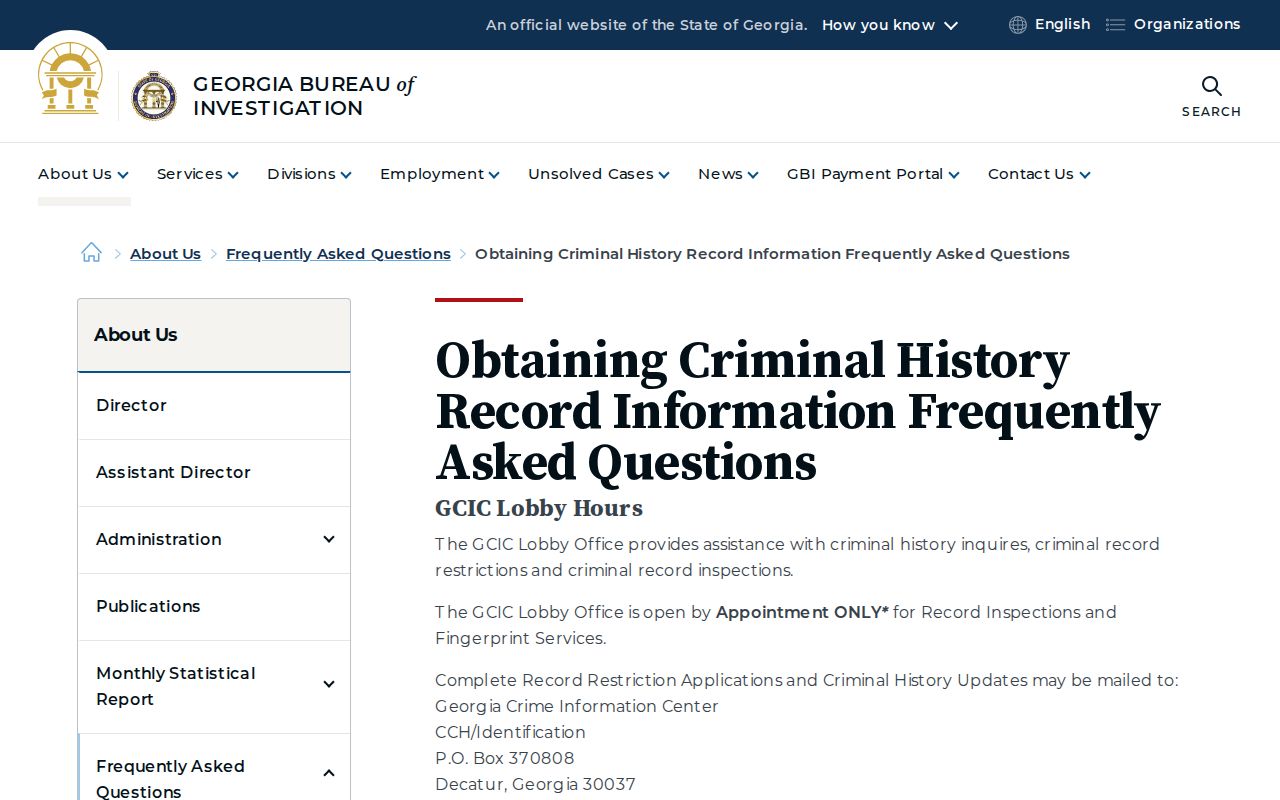
If arrest data is wrong, start with the arresting agency. If the disposition is missing or wrong, contact the clerk or prosecutor that owns it. GCIC says it cannot independently rewrite another agency's submission without proper documentation or authorization.
Booking Logs and Recent Arrests
Taliaferro County publishes no verified official daily arrest log, booking blotter, mugshot gallery, or app-only arrest list. The fastest current method is to call the sheriff and obtain the receiving jail's exact name. Then use only that facility's official roster or telephone channel. No credible official report of a new local booking portal was found in the recent research.
A live roster normally answers a narrow custody question. It may omit released people, transferred people, archive entries, or records delayed by intake. The arresting agency report answers what event was recorded. The court file answers whether charges were filed. GCIC self-review can show linked Georgia arrest cycles and dispositions later. These sources are sequential, not interchangeable.
Taliaferro State Patrol Arrests
Location alone does not decide the records custodian. If a Georgia State Patrol trooper made the arrest, request the crash or arrest record from State Patrol or the Georgia Department of Public Safety. If GBI led an investigation, request from GBI, recognizing that active investigative material may be withheld. For an event inside Crawfordville or Sharon, call city hall to confirm the policing arrangement instead of assuming a city police department exists.
Ask for related products by name. An incident report, dispatch or CAD log, 911 audio, and body-camera footage are not necessarily included in one paper report. Give a narrow date, time, location, incident number, and recording description. The Georgia Attorney General's open-government page explains the request framework and assistance options.
Taliaferro Arrest Record Restriction
A dismissal does not automatically hide the arrest cycle. Georgia uses record restriction under O.C.G.A. § 35-3-37, which limits eligible criminal-history information from ordinary public dissemination. Court-record sealing is a related, separate step. Restricted data is not necessarily destroyed and can remain available to authorized criminal-justice users.
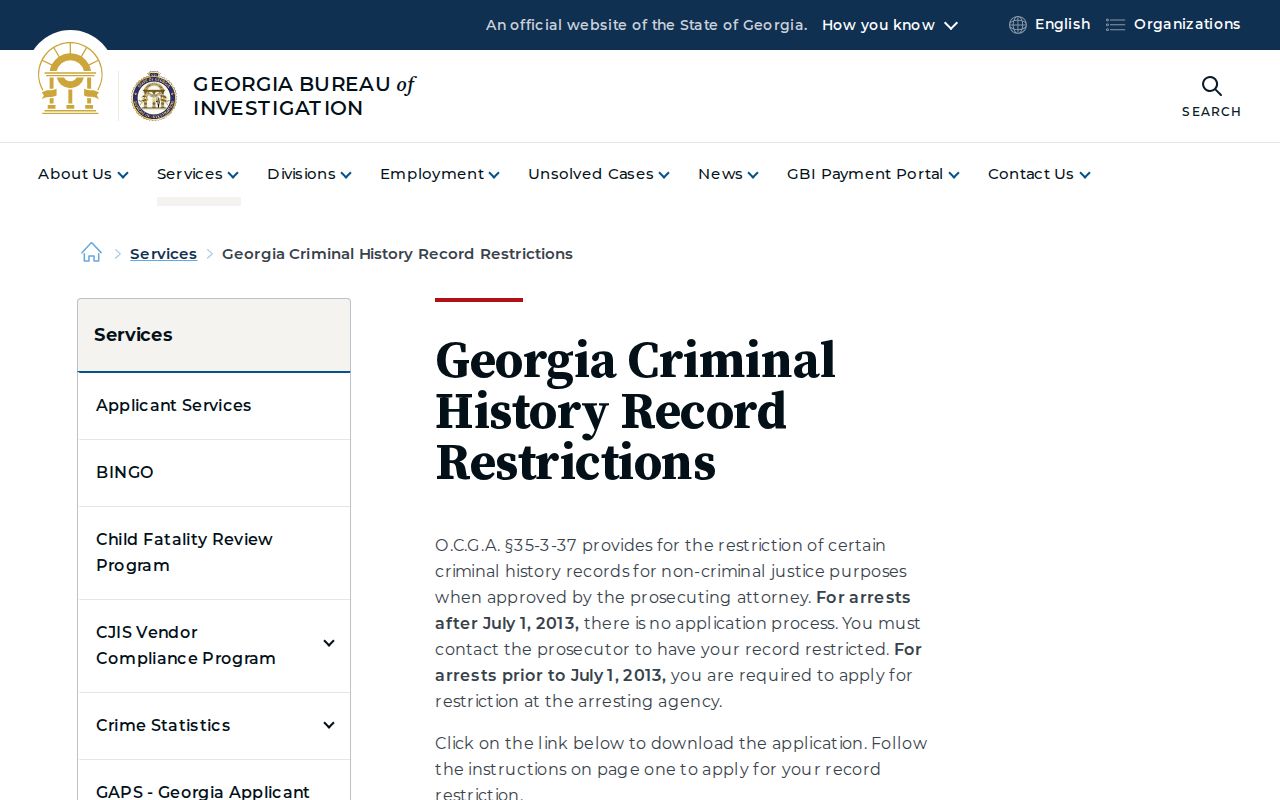
The process depends on arrest date. For an arrest before July 1, 2013, the applicant begins the restriction form with the arresting agency, which forwards it to the prosecutor. For an arrest on or after that date, contact the prosecuting attorney directly. The GBI restriction instructions are the official starting source and supplied this image.
The Georgia.gov restriction workflow explains fees, appeal timing, and processing. Its practical page is shown below.
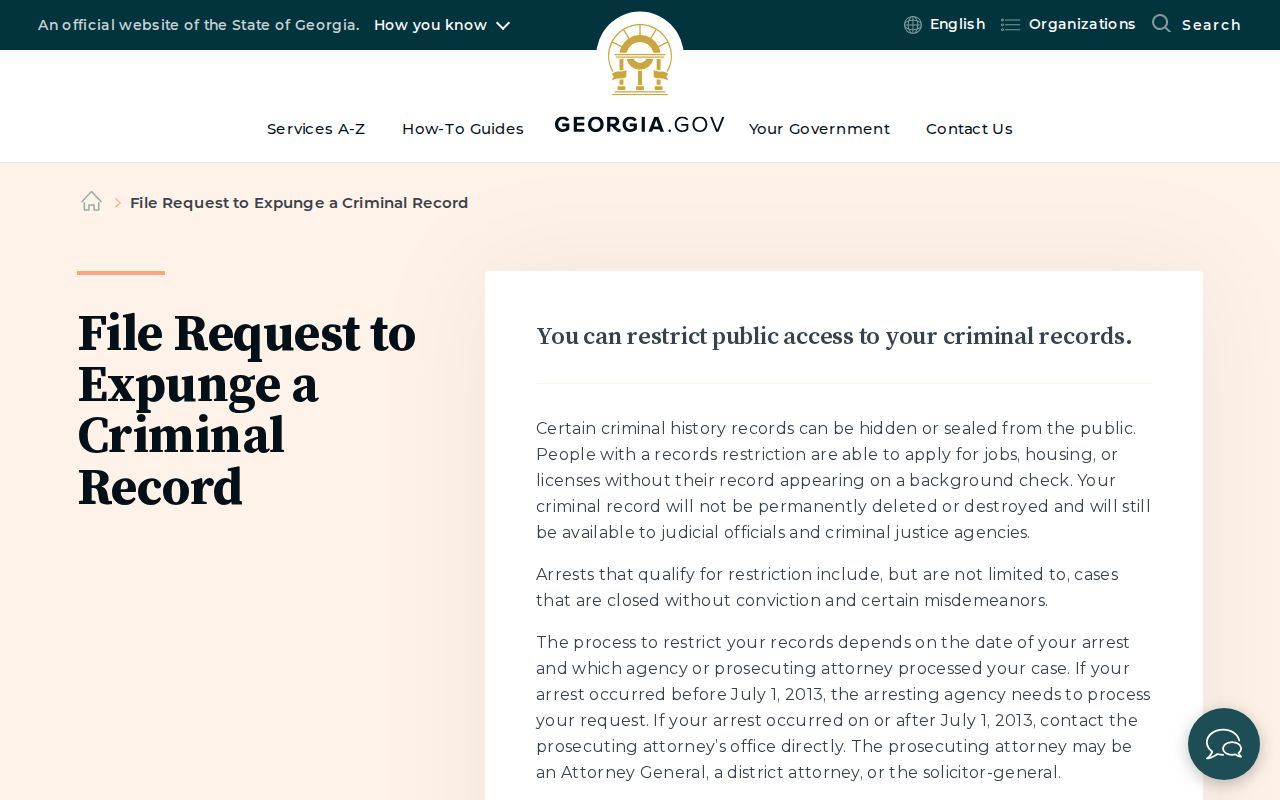
Confirm the right prosecutor. The Toombs Judicial Circuit District Attorney handles felonies, but another office may own a lower-court matter.
Arrests Are Not Convictions
An arrest shows that an agency took someone into custody based on an allegation or warrant. A conviction requires a judgment of guilt after a plea or trial. Charges may be declined, changed, dismissed, placed on dead docket, or resolved with a not-guilty result. Read the final court document before describing the outcome.
| Arrest Record | Conviction Record |
|---|---|
| Created by arresting and booking agencies | Created by the court after a guilty result |
| Proves an arrest or booking was recorded | Proves a judgment of guilt was entered |
| Lives with the agency and custody facility | Lives with the clerk and may be reported to GCIC |
| May end in release, no charge, or dismissal | May lead to sentence, appeal, restriction, or sealing rules |
Note: An arrest is not proof of guilt; use the clerk's filed disposition to verify what happened after booking.